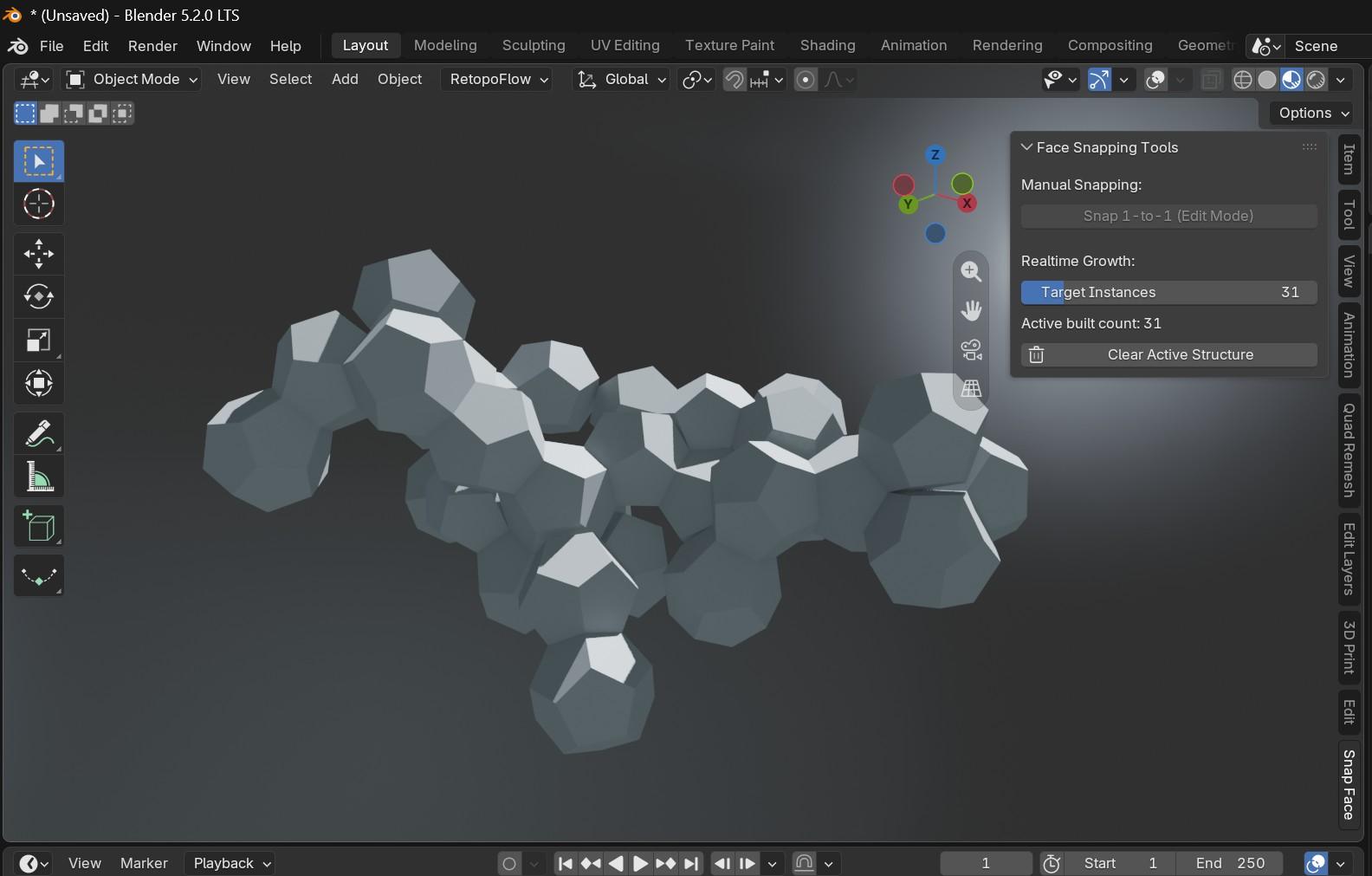
bl_info = {
    "name": "Snap Face to Face",
    "author": "You & Claude",
    "version": (1, 8, 0),
    "blender": (4, 0, 0),
    "location": "View3D > Sidebar (N) > Snap Face",
    "description": "Realtime growing generative structure supporting multiple independent systems.",
    "category": "Object",
}

import bpy
import bmesh
import mathutils
from mathutils.bvhtree import BVHTree
from mathutils import Matrix
import random

# Global registry to hold multiple independent structures keyed by module name
STRUCTURES = {}


def alive(obj):
    return obj is not None and obj.name in bpy.data.objects


def get_structure_key(module, base):
    return f"{module.name}_{base.name if base else 'single'}"


# Geometry helpers
def world_dir(mat, v_local):
    normal_mat = mat.to_3x3().inverted().transposed()
    return (normal_mat @ v_local).normalized()


def project_on_plane(v, n):
    v_proj = v - v.dot(n) * n
    if v_proj.length < 1e-9:
        return None
    return v_proj.normalized()


def get_shrunken_bvh(obj, scale_factor=0.95):
    bm = bmesh.new()
    bm.from_mesh(obj.data)
    bbox_corners = [mathutils.Vector(c) for c in obj.bound_box]
    center = sum(bbox_corners, mathutils.Vector()) / 8.0
    for v in bm.verts:
        v.co = center + (v.co - center) * scale_factor
    bm.transform(obj.matrix_world)
    bvh = BVHTree.FromBMesh(bm)
    bm.free()
    return bvh


def get_bmesh_face_data(obj, face_idx):
    bm = bmesh.new()
    bm.from_mesh(obj.data)
    bm.faces.ensure_lookup_table()
    face = bm.faces[face_idx]
    center = face.calc_center_median().copy()
    normal = face.normal.copy()
    verts = [v.co.copy() for v in face.verts]
    bm.free()
    return center, normal, verts


def get_matching_faces(obj, target_verts, target_area, exclude_idx=None):
    matches = []
    bm = bmesh.new()
    bm.from_mesh(obj.data)
    bm.faces.ensure_lookup_table()
    for f in bm.faces:
        if exclude_idx is not None and f.index == exclude_idx:
            continue
        if len(f.verts) == target_verts and abs(f.calc_area() - target_area) < 1e-4:
            matches.append(f.index)
    bm.free()
    return matches


def snap_objects(src_obj, src_face_idx, tgt_obj, tgt_face_idx):
    src_center_l, src_normal_l, src_verts_l = get_bmesh_face_data(src_obj, src_face_idx)
    tgt_center_l, tgt_normal_l, tgt_verts_l = get_bmesh_face_data(tgt_obj, tgt_face_idx)

    src_mat = src_obj.matrix_world.copy()
    tgt_mat = tgt_obj.matrix_world.copy()

    tgt_center_w = tgt_mat @ tgt_center_l
    tgt_normal_w = world_dir(tgt_mat, tgt_normal_l)
    tgt_verts_w = [tgt_mat @ v for v in tgt_verts_l]
    tgt_rel = [v - tgt_center_w for v in tgt_verts_w]

    src_normal_w = world_dir(src_mat, src_normal_l)
    src_center_w = src_mat @ src_center_l
    src_verts_w = [src_mat @ v for v in src_verts_l]
    src_rel = [v - src_center_w for v in src_verts_w]

    want_normal = -tgt_normal_w
    rot_align = src_normal_w.rotation_difference(want_normal).to_matrix()
    src_rel_aligned = [rot_align @ v for v in src_rel]

    n = len(tgt_rel)
    best_offset, best_error = 0, None
    for offset in range(n):
        v_src = project_on_plane(src_rel_aligned[0], want_normal)
        v_tgt = project_on_plane(tgt_rel[offset % n], want_normal)
        if v_src is None or v_tgt is None:
            continue
        angle = v_src.angle(v_tgt)
        if v_src.cross(v_tgt).dot(want_normal) < 0:
            angle = -angle
        rot = Matrix.Rotation(angle, 3, want_normal)
        error = 0.0
        for i in range(len(src_rel_aligned)):
            rotated = rot @ src_rel_aligned[i]
            target_pt = tgt_rel[(offset - i) % n]
            error += (rotated - target_pt).length_squared
        if best_error is None or error < best_error:
            best_error, best_offset = error, offset

    loc, rot, scale = src_mat.decompose()
    S_verts = [mathutils.Vector((v.x * scale.x, v.y * scale.y, v.z * scale.z)) for v in src_verts_l]
    T_verts = [tgt_verts_w[(best_offset - i) % n] for i in range(len(src_verts_l))]

    p0_s, p1_s = S_verts[0], S_verts[1]
    x_s = (p1_s - p0_s).normalized()
    idx2 = 2
    for i in range(2, len(S_verts)):
        test_y = S_verts[i] - p0_s
        test_y = test_y - test_y.project(x_s)
        if test_y.length > 1e-5:
            idx2 = i
            break
    p2_s = S_verts[idx2]
    v2_s = p2_s - p0_s
    y_s = (v2_s - v2_s.project(x_s)).normalized()
    z_s = x_s.cross(y_s).normalized()
    mat_s = mathutils.Matrix((x_s, y_s, z_s)).transposed()

    p0_t, p1_t, p2_t = T_verts[0], T_verts[1], T_verts[idx2]
    x_t = (p1_t - p0_t).normalized()
    v2_t = p2_t - p0_t
    y_t = (v2_t - v2_t.project(x_t)).normalized()
    z_t = x_t.cross(y_t).normalized()
    mat_t = mathutils.Matrix((x_t, y_t, z_t)).transposed()

    rot_3x3 = mat_t @ mat_s.inverted()
    src_center_s = mathutils.Vector((src_center_l.x * scale.x, src_center_l.y * scale.y, src_center_l.z * scale.z))
    rotated_center = rot_3x3 @ src_center_s
    translation = tgt_center_w - rotated_center

    src_obj.matrix_world = mathutils.Matrix.LocRotScale(translation, rot_3x3.to_quaternion(), scale)


def get_current_module_base(context):
    sel = context.selected_objects
    if not sel or len(sel) > 2:
        return None, None
    module = context.active_object
    if not module:
        return None, None
    base = next((o for o in sel if o is not module), module) if len(sel) == 2 else module
    return module, base


def try_build_root_slots(module, base):
    bm_mod = bmesh.new()
    bm_mod.from_mesh(module.data)
    bm_mod.faces.ensure_lookup_table()
    mod_sel = [f.index for f in bm_mod.faces if f.select]
    if len(mod_sel) != 1:
        bm_mod.free()
        return None, None
    plug_idx = mod_sel[0]
    target_verts = len(bm_mod.faces[plug_idx].verts)
    target_area = bm_mod.faces[plug_idx].calc_area()
    bm_mod.free()

    if base is not module:
        bm_base = bmesh.new()
        bm_base.from_mesh(base.data)
        bm_base.faces.ensure_lookup_table()
        base_sel = [f.index for f in bm_base.faces if f.select]
        bm_base.free()
        if len(base_sel) == 1:
            slots = [(base, base_sel[0])]
        else:
            slots = [(base, idx) for idx in get_matching_faces(base, target_verts, target_area)]
    else:
        slots = [(base, idx) for idx in get_matching_faces(base, target_verts, target_area, exclude_idx=plug_idx)]

    if not slots:
        return None, None
    return plug_idx, slots


def grow(data, context, target_count):
    module = data['module']
    plug_idx = data['plug_idx']

    bm_mod = bmesh.new()
    bm_mod.from_mesh(module.data)
    bm_mod.faces.ensure_lookup_table()
    target_verts = len(bm_mod.faces[plug_idx].verts)
    target_area = bm_mod.faces[plug_idx].calc_area()
    bm_mod.free()

    attempts = 0
    max_attempts = max(1, target_count - len(data['pieces'])) * 6

    while len(data['pieces']) < target_count and data['slots'] and attempts < max_attempts:
        attempts += 1
        slot_pos = random.randint(0, len(data['slots']) - 1)
        tgt_obj, tgt_face_idx = data['slots'].pop(slot_pos)

        new_obj = module.copy()
        new_obj.data = module.data.copy()
        context.collection.objects.link(new_obj)

        snap_objects(new_obj, plug_idx, tgt_obj, tgt_face_idx)
        context.view_layer.update()

        new_bvh = get_shrunken_bvh(new_obj, 0.95)
        collision = any(new_bvh.overlap(tree) for _, tree in data['bvh'])

        if collision:
            bpy.data.objects.remove(new_obj, do_unlink=True)
            continue

        own_slots = get_matching_faces(new_obj, target_verts, target_area, exclude_idx=plug_idx)

        data['pieces'].append({
            'obj': new_obj,
            'parent': (tgt_obj, tgt_face_idx),
            'own_slots': own_slots,
        })
        data['bvh'].append((new_obj, new_bvh))
        for idx in own_slots:
            data['slots'].append((new_obj, idx))


def shrink(data, target_count):
    while len(data['pieces']) > target_count:
        piece = data['pieces'].pop()
        obj = piece['obj']

        data['slots'] = [(o, f) for (o, f) in data['slots'] if o is not obj]
        data['bvh'] = [(o, b) for (o, b) in data['bvh'] if o is not obj]
        data['slots'].append(piece['parent'])

        if alive(obj):
            bpy.data.objects.remove(obj, do_unlink=True)


def execute_generative_build(context):
    if context.mode != 'OBJECT':
        return

    module, base = get_current_module_base(context)
    if module is None:
        return

    target_count = context.scene.snapface_iterations
    key = get_structure_key(module, base)

    # Initialize separate dictionary entry for this unique module/base pairing if missing
    if key not in STRUCTURES or not alive(STRUCTURES[key]['module']) or not alive(STRUCTURES[key]['base']):
        plug_idx, slots = try_build_root_slots(module, base)
        if plug_idx is None:
            return

        STRUCTURES[key] = {
            'module': module,
            'base': base,
            'plug_idx': plug_idx,
            'pieces': [],
            'slots': slots,
            'bvh': [(base, get_shrunken_bvh(base, 0.95))],
        }

    data = STRUCTURES[key]

    if target_count > len(data['pieces']):
        grow(data, context, target_count)
    elif target_count < len(data['pieces']):
        shrink(data, target_count)

    bpy.ops.object.select_all(action='DESELECT')
    if base is not module:
        base.select_set(True)
    module.select_set(True)
    context.view_layer.objects.active = module


def update_iterations_realtime(self, context):
    try:
        execute_generative_build(context)
    except Exception as e:
        print(f"[Snap Face to Face] realtime update error: {e}")


class SNAPFACE_OT_basic(bpy.types.Operator):
    bl_idname = "object.snapface_basic"
    bl_label = "Snap 1-to-1 (Edit Mode)"
    bl_options = {'REGISTER', 'UNDO'}

    @classmethod
    def poll(cls, context):
        return context.mode == 'EDIT_MESH' and len(context.selected_objects) == 2

    def execute(self, context):
        sel = context.selected_objects
        active = context.active_object
        target_obj = next(o for o in sel if o is not active)

        def get_sel_face_edit(obj):
            bm = bmesh.from_edit_mesh(obj.data)
            sel_faces = [f for f in bm.faces if f.select]
            if len(sel_faces) != 1:
                return None
            return sel_faces[0].index

        src_idx = get_sel_face_edit(active)
        tgt_idx = get_sel_face_edit(target_obj)

        if src_idx is None or tgt_idx is None:
            self.report({'ERROR'}, "Each object must have exactly ONE face selected.")
            return {'CANCELLED'}

        bpy.ops.object.mode_set(mode='OBJECT')
        snap_objects(active, src_idx, target_obj, tgt_idx)
        bpy.ops.object.mode_set(mode='EDIT')
        return {'FINISHED'}


class SNAPFACE_OT_clear(bpy.types.Operator):
    bl_idname = "object.snapface_clear"
    bl_label = "Clear Active Structure"
    bl_description = "Delete instances belonging to the current active setup"
    bl_options = {'REGISTER', 'UNDO'}

    def execute(self, context):
        module, base = get_current_module_base(context)
        if module:
            key = get_structure_key(module, base)
            if key in STRUCTURES:
                for piece in STRUCTURES[key]['pieces']:
                    if alive(piece['obj']):
                        bpy.data.objects.remove(piece['obj'], do_unlink=True)
                del STRUCTURES[key]
        return {'FINISHED'}


class SNAPFACE_PT_panel(bpy.types.Panel):
    bl_label = "Face Snapping Tools"
    bl_idname = "SNAPFACE_PT_panel"
    bl_space_type = 'VIEW_3D'
    bl_region_type = 'UI'
    bl_category = "Snap Face"

    def draw(self, context):
        layout = self.layout
        scene = context.scene

        layout.label(text="Manual Snapping:")
        layout.operator("object.snapface_basic")

        layout.separator()

        layout.label(text="Realtime Growth:")
        layout.prop(scene, "snapface_iterations", text="Target Instances", slider=True)

        module, base = get_current_module_base(context)
        current_pieces = 0
        if module:
            key = get_structure_key(module, base)
            if key in STRUCTURES:
                current_pieces = len(STRUCTURES[key]['pieces'])

        layout.label(text=f"Active built count: {current_pieces}")
        layout.operator("object.snapface_clear", icon='TRASH')


classes = (SNAPFACE_OT_basic, SNAPFACE_OT_clear, SNAPFACE_PT_panel)


def register():
    for cls in classes:
        bpy.utils.register_class(cls)

    bpy.types.Scene.snapface_iterations = bpy.props.IntProperty(
        name="Instances",
        description="Drag to grow/shrink the structure in realtime",
        default=10,
        min=1,
        max=200,
        update=update_iterations_realtime
    )


def unregister():
    STRUCTURES.clear()
    for cls in reversed(classes):
        bpy.utils.unregister_class(cls)
    del bpy.types.Scene.snapface_iterations


if __name__ == "__main__":
    register()